Login to Customer Portal
 Contact
 Search
Engineer-to-Order vs Configure-to-Order: How to Find the Right Balance in Complex Manufacturing
How much of your business truly needs fully engineered-to-order products? Learn how to strike the right balance and uncover hidden CTO potential.



How much of your business is truly engineer-to-order, and how much should be?
Engineer-to-Order (ETO) and Configure-to-Order (CTO) are two manufacturing models that determine how products are designed, quoted, and produced.
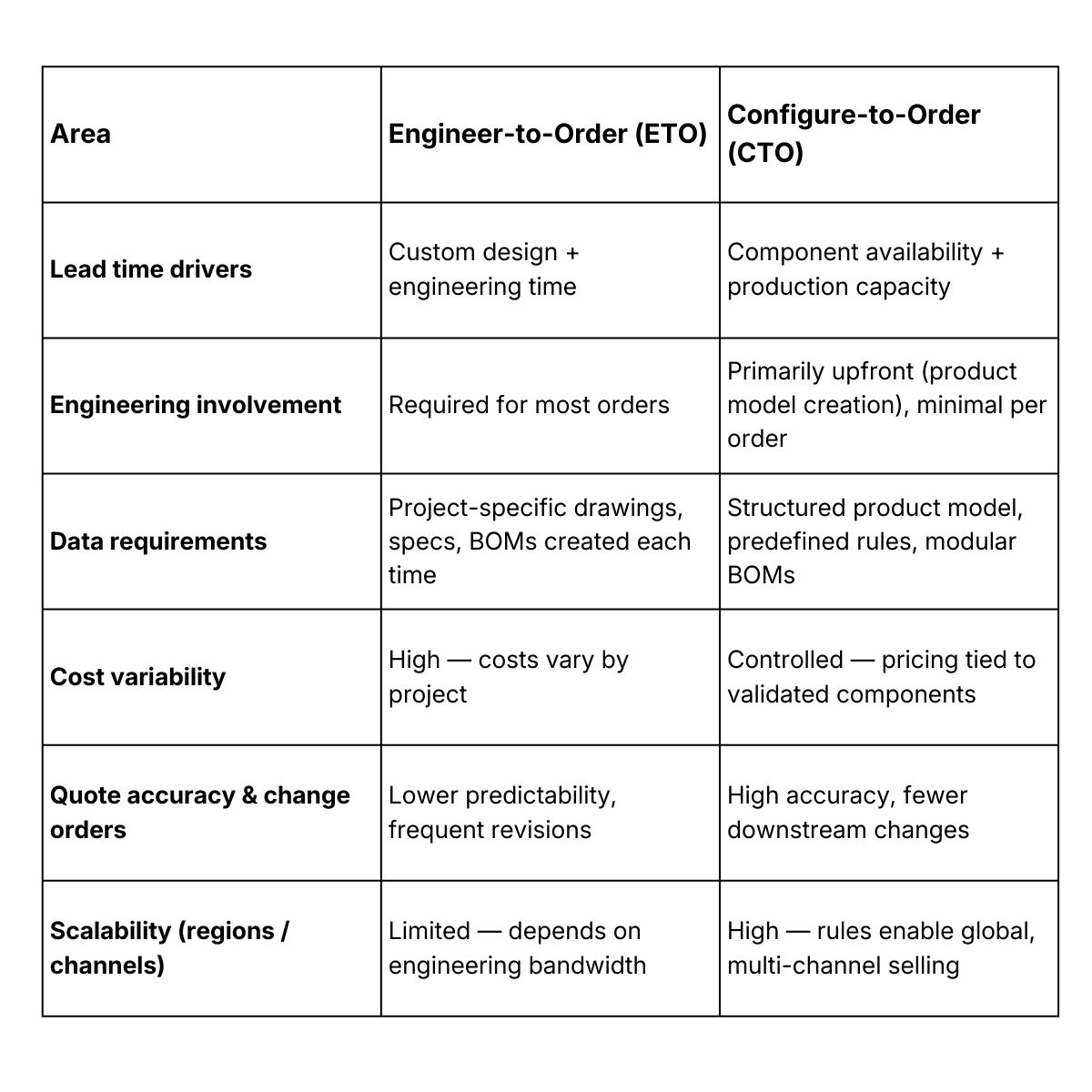
In true ETO manufacturing, every order requires new engineering. Designs start from scratch with each order, and capacity is limited by available engineering headcount. That level of customization can be strategic, but it’s also expensive and hard to scale.
In configure-to-order (CTO), products are built from predefined, standardized modules and rules. Sales can move faster and growth isn’t constrained by engineering bandwidth. But pushing too far can limit flexibility where it actually matters.
Many manufacturers overestimate how much of their portfolio needs to be ETO. As customers reward faster response times and sales volumes increase, having the right hybrid between ETO and CTO manufacturing allows manufacturers to balance innovation with operational predictability.
ETO vs CTO manufacturing: strengths and limitations
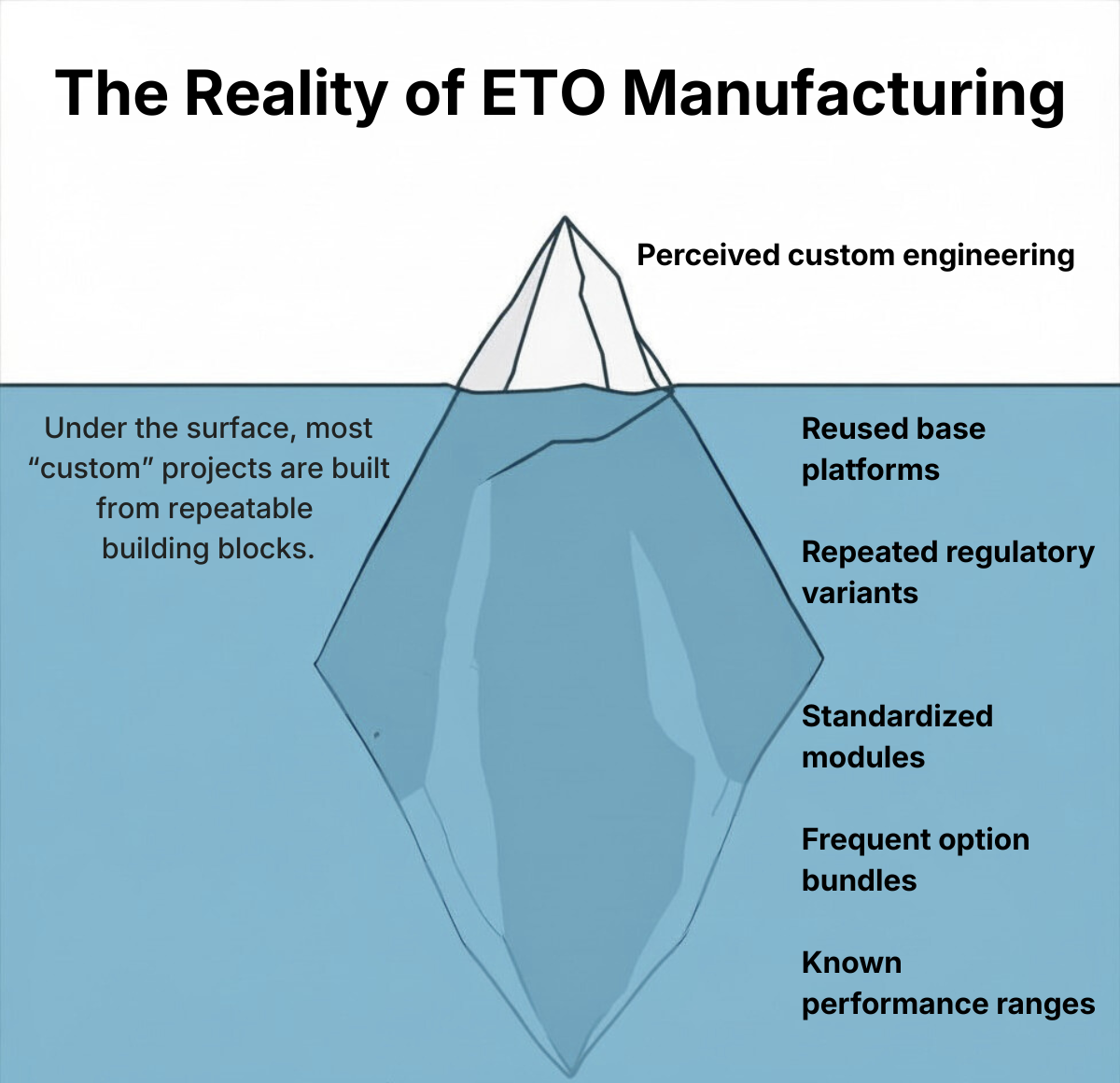
Manufacturers often overestimate their current level of customization due to a misunderstanding of what constitutes ETO and CTO manufacturing.
What is engineer-to-order (ETO) manufacturing?
In true ETO manufacturing, each project is completely unique. Each component is designed or heavily engineered after order intake.
Due to their high customization, unique configurations are often driven by site-specific conditions (e.g., wind loads, snow loads, earthquake loads), regulatory variables (e.g., electrical compliance, pressure vessel compliance, emissions), and customer-specific performance needs (e.g., precision tolerances, torque).
Why adopt ETO?
- Customers have the ultimate flexibility in their solution.
- ETO supports unique or emerging use cases not supported by standard components.
- ETO enables and encourages deep engineering differentiation and innovation.
What are the limitations of ETO?
- ETO manufacturing models have long sales cycles and lead times (up to months or years) due to heavier engineering input and customer scope creep.
- Heavy customization requires more product expertise, which strains engineering and product teams.
- Manufactures face more manual processes and rework as components are not digitally standardized.
- Reliance on engineering makes it difficult to scale sales without adding headcount.
- Lack of predictability in configurations, pricing, and production leads to inconsistent margins.
What is configure-to-order (CTO) manufacturing?
The CTO manufacturing model is based on building products from repeatable, predefined components or assemblies that can be combined in different ways to meet customer needs.
Many manufacturers that believe they operate fully in an ETO model often discover that large portions of their products are actually repeatable. Core components or assemblies are standardized, while only certain elements require customization.
In CTO, engineering knowledge is captured and structured into rules, enabling sales teams—or even customers—to configure valid solutions without requiring engineering involvement for every deal.
It’s important to note that not all CTO models are fully modular in the same way.
- In more advanced, modular CTO models, products are built on a structured architecture (often a 150% Bill of Materials) that consists of a product with an assembly structure where each piece can be switched out with interchangeable components. Larger, more complex products may include multiple layers of assemblies with interchangeable components.
- In other cases, CTO may be less formalized, where teams define what the configuration will be within certain boundaries, without a fully modular structure.
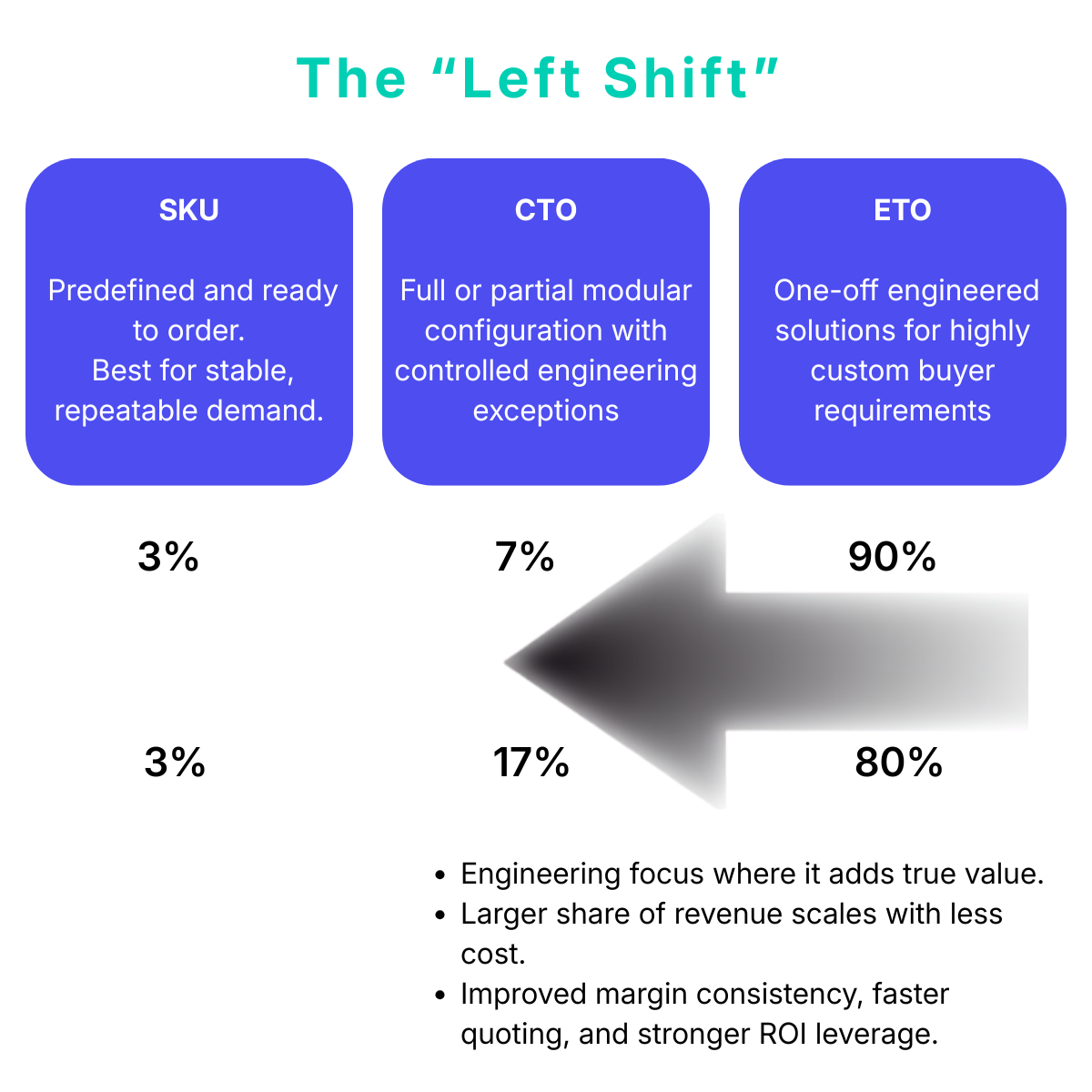
- Many manufacturers operate in a hybrid CTO + ETO model, where standard configurations handle the majority of demand, and true customization is managed through controlled engineering exceptions.
Configure-to-order models versus SKU models
CTO is not the same as a SKU model or standard consumer product.
A SKU model sells fully predefined products — each variant already exists and is ordered as-is. There’s no configuration at the time of sale.
Configure-to-order (CTO) uses standardized components and rules to create a valid, customer-specific solution during the sales process.
If you try to manage high product complexity with pure SKUs, you end up with SKU explosion. If you try to manage it with pure ETO, you overload engineering. CTO sits in the middle.
Why adopt CTO?
- CTO allows faster quoting, because customization affects selection, not core design.
- When components are already validated and established within CPQ, there are fewer configuration and quote errors.
- CTO enables more customer self-service and guided buying, which scales sales processes by reducing the need for always-on sales teams and engineers.
- Manufacturers who have repeatable, standard components have higher data visibility into which variants are actually sold and how often.
What are the limitations of CTO?
- Engineers and product teams often respond with fear of reduced flexibility.
- Standardizing and codifying product and configuration logic requires upfront modeling effort in CPQ.
- CTO requires structured data and teams to be working from the same PLM data.
- Organizational change and change management are trickier when sales and engineering processes must fundamentally change.
For most manufacturers, the real opportunity is not replacing ETO, but shifting more business into structured CTO where possible.
ETO vs CTO: what changes for your business?
When ETO is strategically necessary
It’s common to believe that you “never sell the same thing twice.” While this is on the far side of the spectrum, not all customizations should be eliminated. Engineer-to-order models can be optimized with great success.
ETO remains critical when:
- Truly unique customer requirements drive value.
- Unique requirements lead to new product development or market entry.
- Economically, a specialty project is low-volume but high-margin.
The goal is to reserve engineering effort for high-value differentiation, which requires some transition to CTO manufacturing models.
The business case for increasing CTO manufacturing
Quoting cycles can range from days to months, and buyers expect rapid pricing and quoting, even if price isn’t the final decision factor.
CTO manufacturing brings speed to manufacturers bogged down by engineering or pricing back-and-forth.
In addition to speed and response times—which often determine win rates and competitive positioning—there are several strategic benefits to increasing CTO products.
8 reasons to expand CTO manufacturing
- Sales volumes are rising, but headcount isn’t scaling with demand.
- Distributors, partners, and customers can’t generate accurate quotes independently.
- Revenue growth remains unpredictable and tied to engineering capacity.
- Rework and order errors consume time and erode customer trust.
- Critical product knowledge walks out the door with retiring experts.
- Sales onboarding takes months—sometimes over a year—to reach proficiency.
- Sales execution and customer experience vary across regions and channels.
- SKU sprawl and redundant parts create supply chain inefficiencies you can’t easily untangle.
Common objections to CTO—and how to rethink them
Recalibrating your mix of ETO and CTO products is not a simple switch. It’s no surprise that internal stakeholders will have objections.
“We’ll lose flexibility.”
When you dig deeper into your orders, how many are truly unique?
Focus on identifying which products or features truly require engineering. Moving just a fraction of orders from ad hoc engineering to standardized configuration can improve margins, reduce lead times, and free up engineering capacity. Edge cases can still be managed through controlled engineering escalation, supported by clear approval workflows for exceptions that fall outside standard rules.
“Our products are too complex.”
Complexity is the reason to adopt CTO, not avoid it.
CTO makes complexity manageable through rules, constraints, and guided selling. Without structure, complexity drives longer sales cycles and inconsistent margins. By translating engineering logic into rules and constraints, you enforce valid combinations automatically. The complexity stays behind the scenes; the sales experience becomes guided and reliable.
“Our data isn’t ready.”
Is data messy or missing completely? Is data scattered across multiple PLM systems or are entire data fields missing?
Transition is iterative, not a one-time overhaul. Start with one product line, such as a core product line. Clean and structure data incrementally and treat cleaning data as part of an essential journey toward data maturity.
“Implementation could take years.”
Yes. It’s a journey, but one that has long-term benefits on your top and bottom line.
Remember, value can be realized in phases. Pilots reduce risk, and the ROI from faster quoting and error reduction can offset the investment.
“Engineering will resist this.”
There is always concern about the fear of losing control over product integrity, or that sales will misconfigure complex solutions. Engineers don’t want their expertise undermined or their innovations to be dumbed down.
CTO captures and scales engineering expertise through rules that protect product integrity. Instead of reacting to sales support requests, engineers focus on architecture, innovation, and optimization.
Ready to shift the balance to hybrid ETO-CTO manufacturing?
Shifting from ETO to a more balanced CTO model doesn’t mean sacrificing flexibility or engineering expertise. It means applying structure where it creates scale and protecting customization where it truly adds value. If you’re evaluating how to move in that direction, the next step is a strategy conversation.
Tacton CPQ helps complex manufacturers master ETO and CTO workflows through a constraint-based configuration engine and guardrails that preserve product integrity while giving your customers the flexibility they want.