Back to Resources

Manufacturing’s Top Challenges and How CPQ Solves Them

A common question we get is What Challenges can CPQ Solve? For sales, it's easier than ever to create a customer centric buying journey

Manufacturing’s Top Challenges and How CPQ Solves Them

What Challenges can CPQ Solve?

Precision, efficiency and profitability are all signs of a healthy manufacturing organization, but achieving these goals is a challenge for many businesses. Manufacturing executives face an array of challenges in their quest to hit these goals.

From an unpredictable supply chain, a changing buyer demographic and sustainability initiatives, the manufacturing sector demands adaptability and innovation. However, amidst these demands, several pain points consistently emerge for manufacturing executives, hindering their ability to thrive in an increasingly competitive market.

Understanding the Pain Points:

1. Process Efficiency:

Product complexity and customer demands have made the process of configuring, pricing and quoting products for manufacturers a huge challenge. These inefficiencies are caused by time-consuming, manual processes that are used to create quotes for customers.

Finding ways to cut down on the time required to create quotes will be a major success factor for new solutions. Streamlining these processes is crucial for enhancing efficiency and reducing manual and time-intensive administrative tasks.

2. Cost Reduction and Margin Improvement:

Every manufacturing operation is actively pursuing strategies to reduce operational costs and enhance profit margins. This involves empowering sales teams to focus on selling value rather than solely emphasizing functions and features. Additionally, companies aim to minimize expenditures related to maintaining existing systems and mitigate quoting errors to prevent revenue loss.

3. Sales and Customer Experience Transformation:

A strong momentum in manufacturing exists towards digital transformation initiatives, encompassing the modernization of sales processes, the adoption of cloud-based solutions to enhance scalability and cost-effectiveness, and the integration of new features aimed at bolstering business support capabilities. But with so many options and different paths executives can take it’s difficult to find a solution that can handle all the challenges faced by a modern manufacturing operation.

Companies strive to enhance the purchasing journey and sales strategies by refining e-commerce interfaces and user experiences (UX). Manufacturers need to adopt strategies that make it easy to sell their products, while also creating an exciting buying experience for their customers.

Additionally, they seek to empower dealers and sales representatives with shared and holistic solutions enabling them to generate precise dimensional drawings and quotes swiftly.

5. Sales and Technical Brain Drain

Many manufacturers also face staffing issues, retirements and key member departures can lead to brain drain for the organization. In 2023 alone, manufacturers on average saw turnover rates at a staggering 28.6%. Adopting new solutions and automation can enhance operational efficiency, improve product quality, and streamline processes by reducing the reliance on a few critical resources companies use to quote their products.

6. Sales Execution and Customer Experience Analytics:

Companies are seeking to streamline their operations by consolidating various systems and configurations, aiming to achieve a unified perspective of the sales lifecycle. This consolidation not only enhances accountability but also minimizes the time required for generating quotes.

7. Competitiveness and Market Adaptability:

In the face of escalating competition, companies must remain agile and adaptable. Finding a solution that decreases costs, boosts sales efficiency, and enables quick adaptation to market changes, ensuring competitiveness in the long run will be critical to success. Find out

 How Tacton Addresses These Trends:

CPQ solutions like Tacton offer a comprehensive suite of features tailored to address the unique pain points of manufacturing executives:

Replicating Your Best Sales Reps and Solution Consultants

With Tacton’s advanced configuration it’s easier than ever to guide customers and sales reps through the sales process. This ensures that even less experienced sales reps can make accurate and optimal product configurations that meet customer needs, like what an expert would do.

Tacton also dynamically generates prices and quotes based on the selected configurations, this ensures that pricing is always accurate and competitive, a task that many times requires deep product and market knowledge.

Simplifying Product Configuration:

CPQ enables manufacturers to streamline product configuration by providing intuitive tools for managing complex product catalogs. By centralizing product data and automating configuration processes, CPQ minimizes errors and ensures consistency across quotes. Find out how our customer IMI uses Tacton to manage their global portfolio of products with Tacton.

Automating Quoting Processes:

With CPQ, manufacturers can automate the generation of quotes, reducing the time and effort required to produce accurate proposals. By integrating with CRM systems and ERP software, CPQ streamlines workflows and facilitates collaboration between sales and engineering teams.

Dynamic Pricing Optimization:

CPQ offers advanced pricing capabilities, allowing manufacturers to implement dynamic pricing strategies based on real-time market data and customer insights. By leveraging pricing analytics CPQ helps manufacturers maximize profitability while remaining competitive.

Accelerating Sales Cycles:

By streamlining quoting processes and providing sales reps with access to self-service tools and guided selling workflows, CPQ accelerates sales cycles and improves win rates. Our customer Siemens reduced quoting time from 8 days to minutes.

Guided Selling and Visualization: 

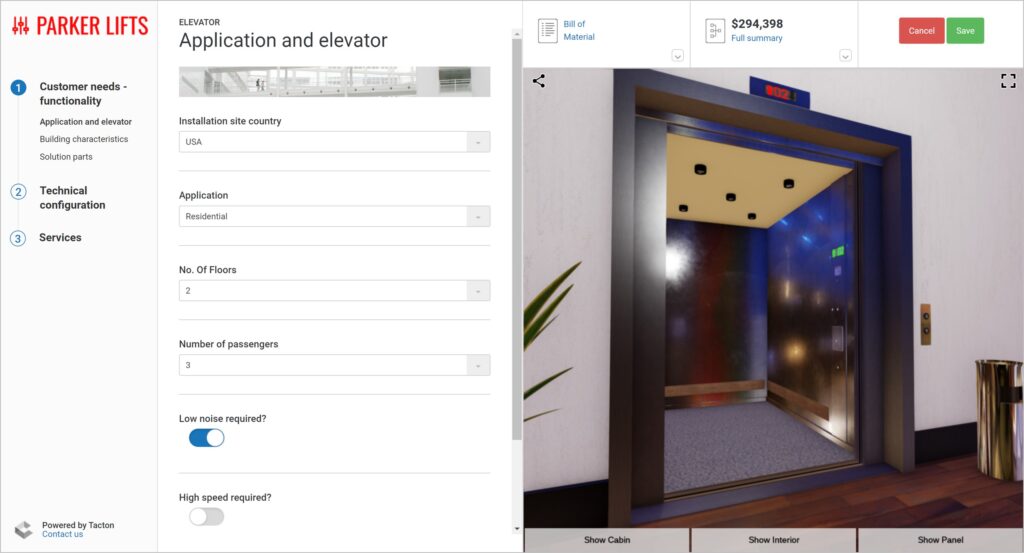
With features like Guided Selling and 3D Visualization, Tacton enables manufacturers to enhance the sales experience and drive customer engagement through interactive product presentations. 

Confidence for the Newest Sales Rep

With the help of CPQ it’s easier than ever to bring your newest sales reps up to speed on the product portfolio. By creating an error-proof and accurate process with CPQ, even new sales reps can build confidence in selling to your prospects.

Customer-Centric Approach:

Tacton’s customer-centric approach ensures end-to-end support, from lead generation to order fulfillment, fostering long-term relationships and customer satisfaction.

Optimize Products Based on Sustainability Requirements:

With Tacton’s Environmental Footprint Configuration it’s easier than ever to integrate with Life-Cycle Assessment tools to empowers your sales rep or end customer to reduce the footprint through product selections to meet their needs and legislative requirements.

Why Now is the Time to Invest in CPQ:

Amidst technological advancements, market dynamics, and strategic imperatives, the urgency to adopt CPQ solutions has never been greater. With Tacton’s proven track record, industry expertise, and sector-specific solutions, manufacturers can overcome their pain points and embark on a journey towards operational excellence and sustainable growth.

Ready to learn more about how CPQ is changing manufacturing? Get in contact with us!

Let’s chat

Back to Resources

Unlocking the Power of Tacton’s CPQ Analytics: Seven Game-Changing Use Cases

Discover these seven CPQ analytics use cases for and how they can help with configuration selections, sales BOMs and more

Unlocking the Power of Tacton’s CPQ Analytics: Seven Game-Changing Use Cases

Complex manufacturing has fundamentally changed in the past decade. Businesses in the industrial, power generation, elevator and other manufacturing sectors have had to change how they operate. Global competition, supply chain interruptions, and labor shortages are just a few of the challenges businesses have faced.

These challenges have left manufacturers no choice but to digitally transform or disappear. Our latest survey found that 64% of manufacturers are either in the early stages, or well into their digital transformation efforts.

Many of these companies are spearheading their digital transformation efforts with CPQ (Configure, Price, Quote) systems because these tools dramatically enhance the efficiency and accuracy of their sales processes, leading to increased customer satisfaction and higher revenue. While customer satisfaction and higher revenue are always on the top of mind for manufacturers, another key feature of CPQ is the wealth of data it provides. This data encompasses configuration selections, sales BOMs, pricing levels, won-lost data and more.

Let’s explore seven use cases that demonstrate how manufacturers can leverage CPQ Analytics to gain valuable insights and drive business decisions. These use cases highlight the unique nature of CPQ data, which is not typically found in other enterprise systems.

What are some common CPQ Analytics Use Cases?

1. Sales Pipeline Analysis

The first use case focuses on sales pipeline analysis. Opportunities can be visualized at various stages of the sales process, from design solution all the way through to order.

With CPQ analytics, it is possible to identify where opportunities are getting stuck, particularly in the final negotiation stage. By examining both the number and the size of opportunities in different stages, efforts can be prioritized to unblock high-value deals. Additionally, the API allows filtering this data by year, providing a temporal perspective on the sales pipeline.

2. Price Positioning Analysis

Next up is price positioning analysis. This analysis helps understand the margin and size of different opportunities.

For instance, patterns in high-margin deals can be seen—whether those deals tend to be won or lost. This analysis can be segmented by application, industry, and year, offering a granular view of pricing strategies. These insights help refine the approach to pricing and ensure competitiveness in the market.


3. Parts Reduction Analysis

The third use case is parts reduction analysis. Here, the choices made by customers during the configuration process are analyzed, focusing on various components and materials.

By examining these choices, parts that are rarely selected can be identified. This insight allows for streamlining product offerings, reducing inventory costs, and focusing on popular options that drive sales. Additionally, visualizing these choices in a 3D environment provides a clearer understanding of customer preferences.

4. Product Market Fit Analysis

Product market fit analysis is the fourth use case. This analysis compares customer requirements with the solutions provided, highlighting any over-dimensioned products.

Using a slider tool, solutions that exceed customer requirements by a significant margin can be filtered out. With Tacton, This helps determine if new variants need to be developed that better match customer needs, ensuring products are neither overbuilt nor under-equipped. Refinement and aggregation of the data is handled by the manufacturers preferred Business Intelligence tool such as Qlik, Microsoft BI or Tableau.

5. Service Upsell Analysis

The fifth use case is service upsell analysis. This analysis examines additional services chosen by customers, such as express installation, and their relevance across different industry segments.

By identifying which segments—like medical or public transport—opt for these services, marketing strategies and upsell efforts can be tailored more effectively. Understanding these choices during the configuration process helps align service offerings with customer needs.

6. Customer Value Driver Analysis

Finally, customer value driver analysis focuses on high-importance questions within the configuration process, which are crucial to customer satisfaction.

Analyzing whether customers are actively choosing these options or simply accepting default suggestions reveals how relevant these value drivers are across various industries. This insight helps refine the configurator and improve customer engagement.

7. Quoting Analytics

The additional section is quoting analytics. This use case involves analyzing the quoting process to identify trends and inefficiencies.

By leveraging CPQ analytics, data on quote generation times, approval rates, and conversion rates can be gathered and examined. This analysis can reveal bottlenecks in the quoting process, highlight the most and least effective sales tactics, and provide insights into quote acceptance patterns. Understanding these factors helps streamline the quoting process, ensuring faster turnaround times and higher quote acceptance rates.

In closing

Uncovering and utilizing the wealth of data that comes from CPQ analytics can be a true game changer for manufacturers. With this data it can be easier than ever to understand products, customer needs and more while creating actionable insights to make it easier for your teams to sell their products.

Check out more info about CPQ analytics here! 

Back to Resources

Navigating the Future: Insights from The State of Digital Manufacturing 2024

The state of digital manufacturing survey is here. Find out more how manufacturers are tackling their sales challenges with CPQ

Navigating the Future: Insights from The State of Digital Manufacturing 2024

In the quickly changing landscape of manufacturing, adaptation isn’t just a choice—it’s a survival strategy. The fourth edition of “The State of Digital Manufacturing 2024: Unlocking the Power of Digital Transformation,” provides a comprehensive look into the industry’s journey towards resilience and innovation. Through surveys and analysis, we unveil key insights that illuminate the path forward for manufacturers worldwide.

As part of our annual survey, we asked manufacturers about Digital Transformation efforts, 2024 Priorities and Sustainability. In addition to that, we also analyzed how the maturity of digital implementations impacts several areas of their business such as revenue generation, profitability & productivity. Our findings clearly indicate that manufacturers who are advanced in their digital transformation projects realize much more value than those who haven’t planned or are just starting out. Let’s review our key findings in this area:

Digital Transformation: A Strategic Imperative

The tumultuous events of recent years—from the pandemic to market fluctuations—have underscored the need for agility and foresight in manufacturing. Digital transformation emerged not just as a buzzword but as a strategic imperative, offering a lifeline for those seeking to enhance efficiency, optimize resources, and fortify operations.

Our findings reveal a significant divide between manufacturers embracing digitalization and those hesitating on the sidelines. Advanced digital implementations correlate with enhanced profitability, increased sales, and improved productivity. Companies at the forefront prioritize investment initiatives such as supply chain optimization, digitalization of internal processes, and AI integration, reaping the rewards of innovation and forward thinking.

Get the complete survey

The Impact of Delaying Transformation

Delaying digital transformation can have significant consequences for manufacturers, as evidenced by the data highlighting the benefits of advanced digital implementations:

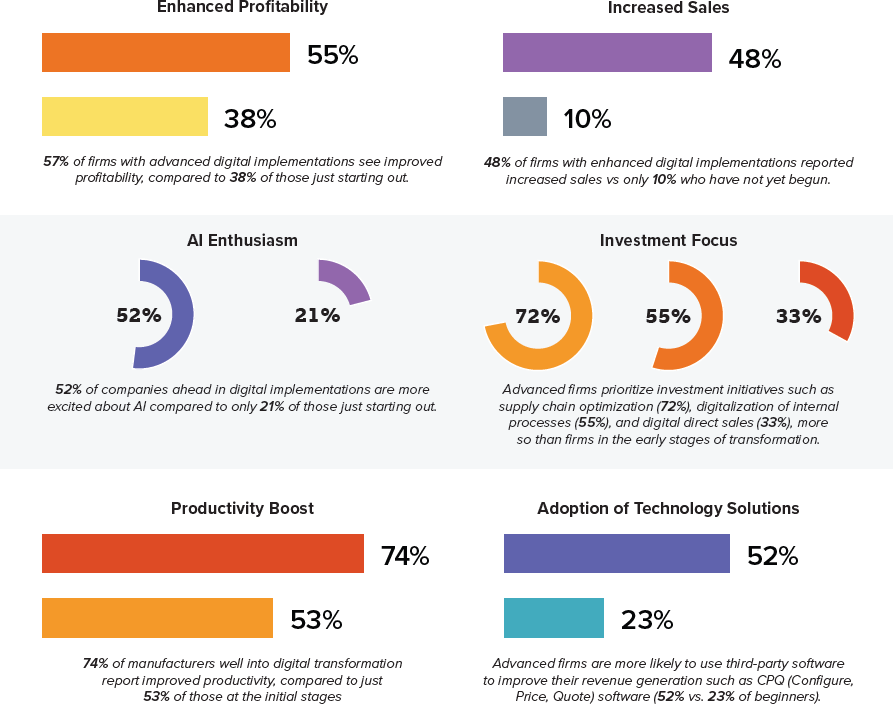
Enhanced Profitability: Advanced digital implementations correlate with improved profitability, with 57% of firms benefiting compared to 38% at early stages. Delaying transformation hinders process optimization, cost reduction, and revenue maximization, affecting the bottom line.

Increased Sales: Firms with advanced digital implementations see a notable increase in sales (48%), while those lagging report only 10% growth. Digital technologies drive sales by reaching new markets, streamlining processes, and enhancing customer experiences. Delaying transformation risks missing out on sales opportunities and falling behind competitors.

Productivity Boost: Manufacturers in advanced digital stages experienced improved productivity (74%) compared to those at initial stages (53%). Digital tools automate tasks, optimize workflows, and empower employees, enhancing efficiency. Delaying transformation reduces productivity gains and hampers agility in meeting market demands.

However, delaying digital transformation comes at a cost. Laggards risk falling behind in a competitive landscape shaped by rapid technological advancements. With each passing day, the gap widens between those harnessing the power of digital tools and those clinging to outdated practices. Enhanced profitability, increased sales, and productivity gains remain elusive for those resistant to change.

Priorities in a Shifting Landscape

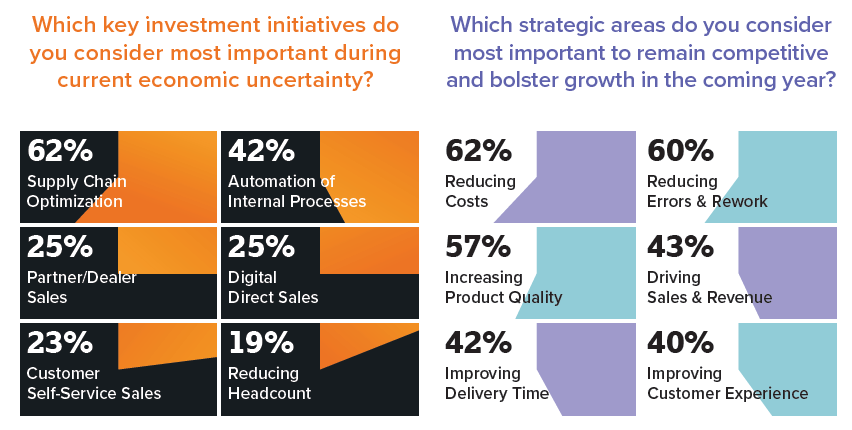
As the economic outlook fluctuates, manufacturers face critical decisions about where to allocate their resources. Reducing costs, minimizing errors, and enhancing product quality emerge as top priorities in navigating uncertain times. Supply chain optimization remains paramount, underscoring the importance of resilience and adaptability in an interconnected global market.

Reducing costs has remained the most important area for manufacturers to bolster growth in 2024. This can be attributed to companies trying to maximize profit and reduce risk with the possibility of an uncertain economy.

Reducing errors and rework is vital for manufacturers as it directly impacts financial efficiency, product quality, and brand reputation, these are just a few reasons why there was a 13% increase in these initiatives since last year. Minimizing mistakes not only cuts additional costs but also ensures consistent high-quality products, enhancing customer satisfaction and safeguarding the company’s image

Artificial Intelligence

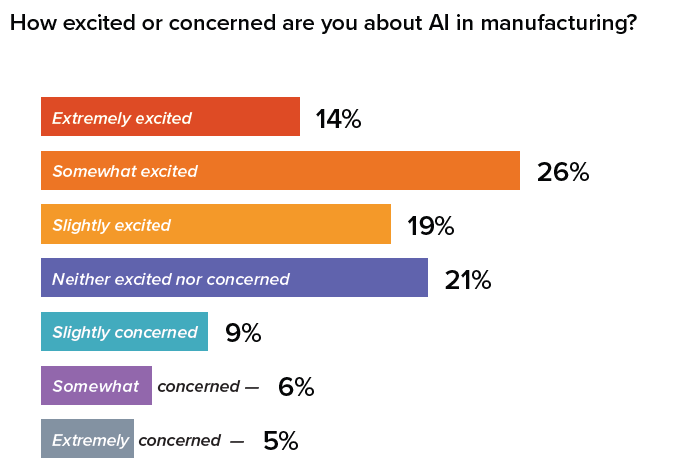
59% of our survey respondents are showing some level of excitement for AI in their manufacturing process. This group views AI as a catalyst for unprecedented innovation, efficiency, and competitiveness. They foresee a future where intelligent machines optimize processes, enhance productivity, and contribute to the development of cutting-edge products.

Delaying digital transformation, especially in adopting AI, can severely impact manufacturers:

Competitive Gap: Companies advanced in digitalization are much more excited about AI (52%) than those just starting out (21%). This indicates a significant competitive disadvantage for laggards, as AI drives insights, efficiency, and personalized experiences crucial for sales success.

Sustainability: A Cornerstone of Success

In an era defined by environmental consciousness and regulatory scrutiny, sustainability takes center stage. Manufacturers recognize the intrinsic link between sustainability initiatives and long-term success. Embracing sustainable practices not only meets consumer demands but also drives innovation, fosters resilience, and enhances brand reputation.

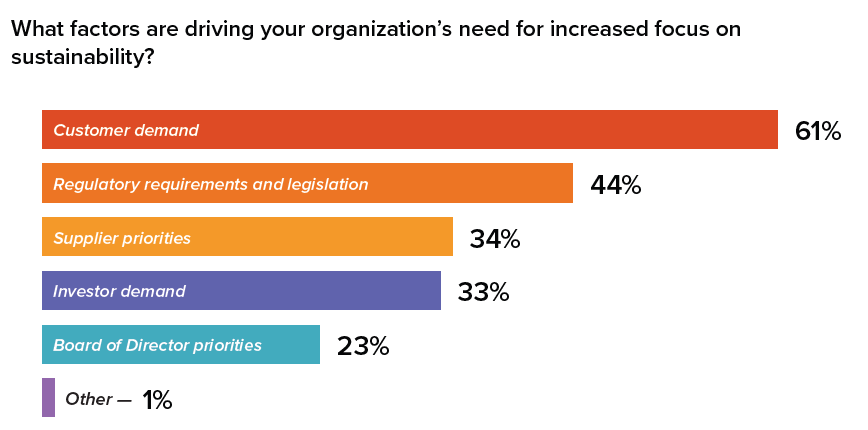
Manufacturers are increasingly propelled towards sustainability by a two-fold force: 61% respond to the demands of environmentally conscious consumers seeking products with minimal environmental impact.

Simultaneously, 44% are driven by a shifting regulatory landscape, including initiatives like the EU Green New Deal and the SEC climate disclosure Rule. These regulations set higher standards, compelling manufacturers to adopt sustainable practices not just for compliance but as a strategic necessity.

Looking Ahead with Tacton

As manufacturers embark on the journey ahead, Tacton stands as a trusted partner, empowering businesses to navigate complexities and seize opportunities. With our industry-leading CPQ solution, manufacturers can efficiently manage product variations, meet dynamic customer expectations, and thrive in the competitive landscape of 2024 and beyond.

In conclusion, “The State of Digital Manufacturing 2024” offers a roadmap for manufacturers navigating an era of unprecedented change. By embracing digital transformation, prioritizing sustainability, and leveraging innovative solutions, businesses can chart a course towards resilience, growth, and success in the years to come.

Get the full survey results 

Back to Resources

The Rise of e-commerce for Manufacturing

e-commerce for manufacturing is changing how business, dealers sell as well as how customers buy. But how did we get to this point and where to next?

The Rise of e-commerce for Manufacturing

How CPQ is Revolutionizing Manufacturing E-commerce: A Game-Changer for Customers

The demand for e-commerce for manufacturing has rapidly changed from a low priority to a top priority in the past decade alone. With nearly every industry shifting to an online buying journey it’s critical for manufacturers to offer a fully integrated e-commerce journey for customers.

While this is commonplace in other industries such as retail, e-commerce for manufacturers has at times been a long, slow journey. Many manufacturers are wondering how we got to this point and are looking for ways to transform how they deal with online selling, to understand where e-commerce for manufacturing is going, we must understand how we got here.

In today’s fast-paced digital economy, manufacturers are continuously striving to enhance their customer experience while streamlining their internal processes. With the rise of e-commerce, manufacturers are increasingly turning to Configure, Price, Quote (CPQ) solutions to not only optimize their sales operations but also to empower customers with seamless and personalized buying experiences. CPQ is emerging as the linchpin in manufacturers’ efforts to enable e-commerce, driving efficiency, accuracy, and customer satisfaction to new heights.

The Evolution of Manufacturing E-commerce

Gone are the days when purchasing from a manufacturer involved lengthy back-and-forth communication, paper catalogs, and manual quoting processes. In the digital age, customers expect the same level of convenience and customization from manufacturers that they experience when buying from consumer-oriented e-commerce platforms.

Manufacturers recognize this shift in customer expectations and are adapting by embracing e-commerce channels. However, unlike retail e-commerce, where products are often standardized, manufacturing involves complex, configurable products that require tailored solutions. This is where CPQ comes into play.

Now that the buying profile of manufacturers is changing to a younger, more online buyer it is as critical as ever to be able to actually sell highly-configurable products online. While many manufacturers we’re in the beginning phases of enabling e-commerce for customers, the COVID-19 Pandemic accelerated efforts to sell online. After the challenges and stress the pandemic put on manufacturers, many are now seeing the importance of e-commerce:

According to a PwC survey,

66% of US Manufacturers agree that implementing e-commerce over the next two years is a “high” or “very high” priority” 

The Role of CPQ in Manufacturing E-commerce

CPQ software enables manufacturers to efficiently manage complex product configurations, pricing, and quoting processes. By integrating CPQ into their e-commerce platforms, manufacturers can provide customers with a user-friendly interface to configure products according to their unique requirements. This level of customization not only enhances the buying experience but also ensures that customers receive accurate quotes in real-time.

Here’s how CPQ is revolutionizing manufacturing e-commerce:

Streamlined Configurability:

CPQ solutions allow customers to easily customize products by selecting various features, options, and accessories through an intuitive interface. Whether it’s specifying dimensions, materials, or functionalities, customers can configure products according to their exact needs, leading to increased satisfaction and reduced order errors.

Dynamic Pricing:

With CPQ, manufacturers can implement dynamic pricing strategies based on factors such as product configurations, quantity discounts, and contract pricing. This ensures that customers receive fair and transparent pricing while maximizing revenue for manufacturers. Real-time pricing calculations enable customers to make informed decisions without delays or uncertainties.

Accelerated Quoting Process:

Traditionally, generating quotes for complex products could take days or even weeks due to manual calculations and approvals. CPQ automates the quoting process, significantly reducing turnaround times. Customers receive accurate quotes instantly, empowering them to make purchasing decisions quickly and efficiently.

Integration with CRM, ERP and more:

Integrating CPQ with CRM, ERP, is instrumental in optimizing manufacturing operations and delivering exceptional customer experiences. By harnessing the capabilities of these integrated systems, manufacturers can streamline workflows, improve data accuracy, and foster greater customer satisfaction. As the manufacturing landscape continues to evolve, seamless integration across sales, manufacturing, and customer service functions will remain essential for driving growth and maintaining competitiveness.

An expectation of Self-Service

With the accuracy needed for custom product quotes it’s important to implement products like CPQ as a solution that enables e-commerce for manufacturing. Proving fast accurate products will help customers get what they need when they need it.  This has created a shift that enables customers to buy using self-service without interacting with a sales team.

Gartner research reveled that 75% of B2B buyers prefer a rep-free sales experience.

With that in mind it’s as important as ever to offer buyers multiple ways to buy your products.   Enabling an online shopping cart makes it easy for customers to buy from home, the warehouse, or in the field for an expedited process. A great self-service experience for manufacturers will highlight the value of any specific product.

A move towards a seamless experience

Omnichannel has been a popular buzzword across industries for the last few years. Simply put an omnichannel experience for manufacturing customers creates a seamless, multi-touchpoint buying experience. Manufacturers have failed to create an experience that is like Amazon or big retailers, which lets them know the status of their products after a purchase. As reported by Gartner, B2B customers spends merely 5% of their buying journey with your sales reps. Manufacturing companies need to find ways to influence customer decisions, especially early in buying journey. With that in mind, many manufacturers’ have shifted to creating an omnichannel experience that will keep the customer close, informed, and ready to buy again.

Customers want to have a unified experience that gets them their products from any channel at any time. Your customers want to be able to check the status of every order whether it’s in design, in production, or being shipped to their office. Without a connected experience, customers will opt for companies that let them know every detail about the product they’ve purchased.

Putting the product at the center of the e-commerce journey

Product information is nearly as important as the final product that’s delivered to your customer’s door. But many manufacturers have failed to give anything more than text-based product descriptions coupled with CAD drawings to their customers.

Ask yourself a simple question, when was the last time you bought any product site unseen? Without proper visuals in an e-commerce shopping cart manufacturers will continue to struggle selling to an increasingly demanding customer pool. That’s why it’s important to enable customers to be as informed as possible about your product offering by giving them visuals and tech specs.

Visual configuration for manufacturers has made it easier than ever to not only give visuals but let customers build their own products that are 100% configurable. This will lend trust to your business while also providing a new exciting way to showcase your products, online, anytime.


The change is here are you ready?

Simply put, if manufacturers fail to offer an e-commerce journey for their customers they will struggle to sell and ultimately lose to the competition who enable an exciting and easy buying journey. With so much at stake it’s time to start looking for solutions that transform how to sell highly-configurable products. Setting up an e-commerce solution coupled with CPQ can help make your business the envy of the industry by creating quick, accurate quotes that can be sold bought and sold online.

If you want to learn more on how Tacton CPQ Omnichannel can reinvent your go-to-market  – even for highly individualized industrial products – head over to our web page or schedule your personal demo today!

Back to Resources

Navigating the Vehicle Dealership Model Transformation with Omnichannel, Visualization, and Self-Service Sales Capabilities

The vehicle dealership model transformation is here for heavy and specialty vehicle manufacturers, and CPQ is at the center of the journey

Navigating the Vehicle Dealership Model Transformation with Omnichannel, Visualization, and Self-Service Sales Capabilities

Specialty and Heavy Vehicle Dealership Models are changing quickly

The heavy & specialty vehicles industries represent an industry dedicated to designing and manufacturing commercial vehicles tailored for specific functions across diverse fields such as trailers, RVs, construction, mining, agriculture, and other heavy-duty applications.  

These vehicles are customized with advanced features and technologies to address unique operational demands, driving continual innovation and adaptation to meet the evolving needs of specialized applications.  

In today’s rapidly evolving vehicle industry, sales strategies face three critical challenges:

  1. Dealership Model Transformation: The shift towards direct sales and online platforms challenges traditional dealership models. To remain competitive, manufacturers must adapt their sales strategies and customer engagement approaches significantly. 
  2. Omnichannel Sales: Providing a seamless omnichannel experience requires integration across multiple platforms and channels. Failure to offer a customized buying experience while maintaining brand cohesion can hinder success. 
  3. Customer Self-Service: Increasingly, customers expect the ability to customize and purchase vehicles online without direct sales assistance. 

Vehicle Dealership Model Transformation Affecting Heavy & Specialty Vehicle Sales 

Today’s buyers are no longer content with the traditional, linear path to vehicle purchase; they demand a seamless, personalized experience that spans digital and physical locations.  

The New Customer Journey in Commercial Vehicle Sales 

The journey of purchasing a commercial vehicle has expanded beyond the dealership’s showroom to include digital exploration, comparison, and customization, and frankly – to resemble the consumer buying experience and expectation. Modern customers start their journey online, expecting to research, configure, and even negotiate deals in a virtual space before they consider a visit to a physical location.  

This shift necessitates a unified approach to sales, one that Configure, Price, Quote (CPQ) software is uniquely equipped to provide. 

The Omnichannel Sales Strategy  

CPQ software integrates into the dealership’s sales strategy, offering a cohesive experience for the buyer, whether they’re online, on their phone, or in the showroom. Here’s how CPQ solutions are transforming the vehicle sales process: 

Digital Showrooms and Vehicle Configurators 

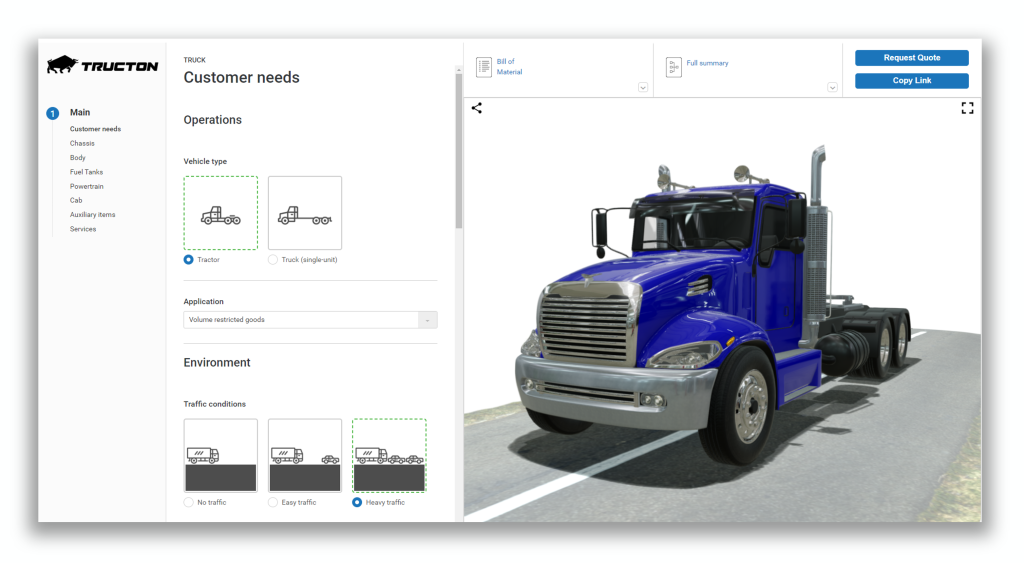
CPQ solutions empower dealerships to create online showrooms and detailed vehicle configurators, allowing customers to explore options, customize their vehicle to their preferences, and understand pricing in real-time — all from the comfort of their home. 

Unified Customer Data for Personalized Engagement 

By centralizing customer data from various touchpoints, CPQ enables dealerships to offer personalized engagement and recommendations. Sales representatives gain insights into a customer’s online activities, preferences, and interactions, allowing for tailored conversations and offers when the customer enters the dealership. 

Enhancing Mobile and Social Media Sales Channels

With CPQ, manufacturers can extend their sales channels beyond the traditional. Customers can configure their vehicles via a mobile app, engage with dealers through social media platforms, and even complete parts of the sales process virtually, ensuring a seamless transition between channels. 

Seamless In-Store Experiences Augmented by CPQ

When a customer visits the showroom, the dealership staff can access the configurations and preferences saved online, thanks to CPQ integrations. This continuity ensures that the in-person experience is not just a repeat of online activities but an enhanced phase where sales representatives can offer deeper insights, finalize configurations, and close deals with confidence. 

Overcoming Challenges with CPQ

Transitioning to an omnichannel sales model with CPQ does pose challenges, including the integration with existing systems and training staff to utilize new tools effectively. However, the return on investment is substantial, offering dealerships the ability to meet modern consumer expectations, streamline the sales process, and increase customer satisfaction and loyalty.

Data Privacy and Security

With CPQ solutions, managing customer data across multiple channels becomes more secure and compliant with privacy regulations. CPQ platforms are designed with robust security measures to protect sensitive customer information, ensuring trust and compliance. 

Embracing Self-Service Sales in the Heavy & Specialty Vehicle Industry

In the context of the evolving vehicle dealership model, self-service sales capabilities are becoming increasingly pivotal. The shift toward digitalization, accentuated by the demands of modern consumers for autonomy and instantaneity, has made self-service an essential component of the sales strategy in the heavy and specialty vehicle sector.

Empowering Customers with Information and Control

Self-service in vehicle sales allows customers to take control of their buying journey, offering them the ability to explore, configure, and even purchase vehicles without direct interaction with sales personnel. This capability aligns with the preferences of today’s digital-savvy, sustainable buyers, who value the convenience and speed of online transactions.

  • Interactive Online Configurators: By providing detailed, user-friendly configurators online, dealerships enable customers to tailor vehicles to their exact specifications. This not only enhances the customer experience but also streamlines the sales process, as the configurations provide a solid starting point for any subsequent sales discussions. 
  • Comprehensive Product Information: An essential element of effective self-service is access to detailed, clear, and accessible product information. This ensures that customers can make informed decisions, reducing the need for clarification from sales staff and increasing customer confidence in the purchase. 
  • Online Pricing and Financing Tools: Transparent pricing and accessible financing options are crucial for empowering customers to make purchase decisions independently. By offering these tools online, dealerships can facilitate a smoother, faster sales process that meets the expectations of modern consumers. 

Integrating Self-Service with Personalized Sales Support

While self-service capabilities offer numerous advantages, they are most effective when integrated into a broader, omnichannel sales strategy that includes personalized support: 

  • Seamless Transition to Sales Support: While many customers appreciate the ability to control their journey, access to expert assistance when needed is vital. Dealerships can integrate chatbots and live chat options, ensuring that customers can easily transition from self-service to human support. 
  • Data-Driven Personalization: The data gathered from customers’ online activities can be leveraged to provide personalized assistance when they choose to engage with sales staff. This integration ensures that the sales team is well-informed about the customer’s preferences and requirements, facilitating more meaningful and efficient interactions. 
  • Consistent Omnichannel Experience: Ensuring consistency across all channels—whether online, in-app, or in-store—is crucial for maintaining customer trust and satisfaction. By providing a unified experience, dealerships can reinforce their brand and build stronger customer relationships. 

A modern CPQ is the answer for a changing vehicle dealership model 

As manufacturers gear up for the challenges of 2024, the quest for solutions addressing high-variance products and customer demands remains paramount for sustained success. In this pursuit, Tacton Configure, Price, Quote (CPQ) stands as a strategic ally.

Building on our proven track record as the industry leading CPQ solution, Tacton empowers manufacturers to efficiently navigate intricate product variations and meet dynamic customer expectations. As the industrial landscape evolves, Tacton continues to be the go-to solution, providing manufacturers with the agility and precision needed to thrive in the complex and demanding market of 2024 and beyond.

Ready to learn more from our industry experts?

Let’s chat!

Back to Resources

Innovation Redefined: Tacton’s Trail to CPQ Leadership for Manufacturers

Tacton has demonstrated CPQ leadership for manufacturers for over 25 years. Find out how we are setting the bar high for our customers!

Innovation Redefined: Tacton’s Trail to CPQ Leadership for Manufacturers

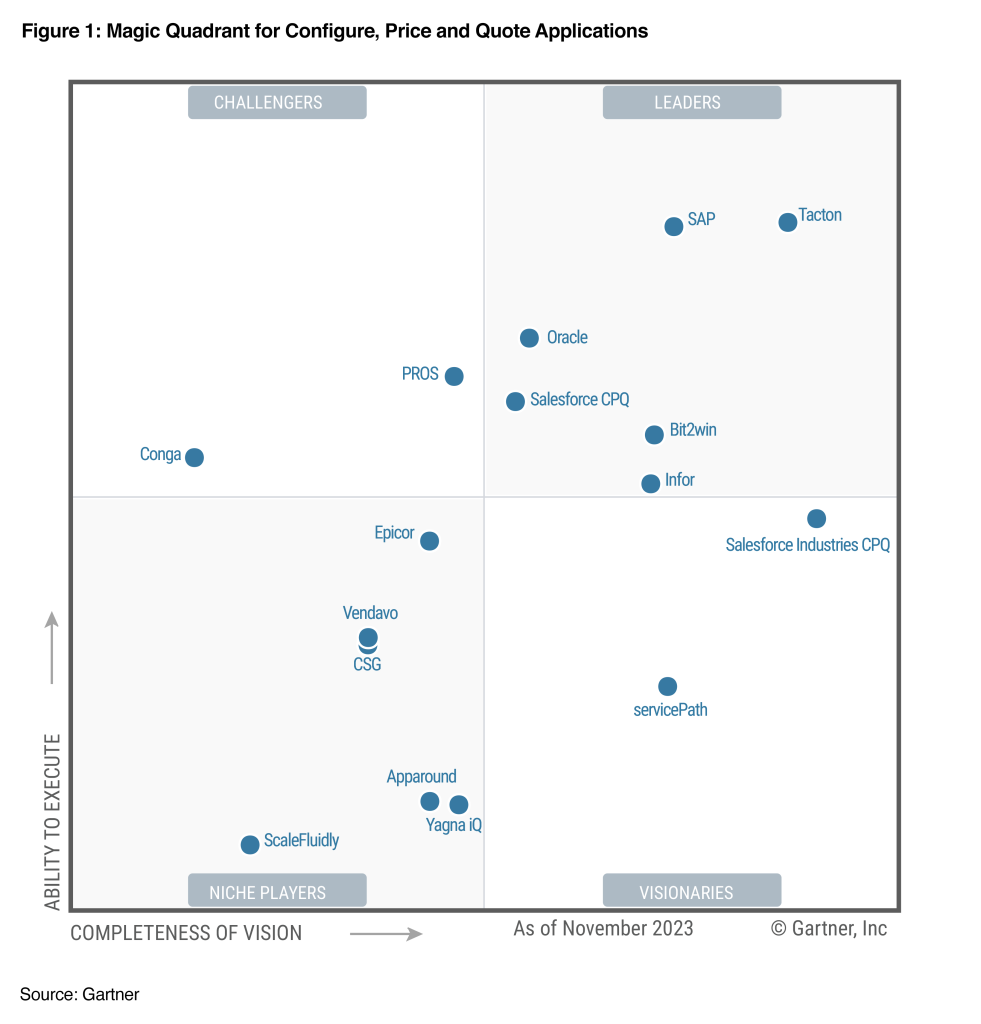
In case you missed it, Tacton was recognized in the Leaders Quadrant in the 2023 Gartner® Magic Quadrant™ for Configure, Price and Quote Applications. This is the second consecutive year we have been named a Leader, and the sixth year in a row we have made the quadrant.  

With back-to-back acknowledgments as a leader, we have demonstrated our commitment to innovation and customer-centricity in delivering our cutting-edge CPQ solution. With 31% of manufacturers dealing with quality issues when quoting their products, many businesses are looking into how CPQ can revolutionize their quoting process. Let’s delve into the reasons behind Tacton’s consistent recognition and explore how we continue to redefine the CPQ landscape. 

The #1 CPQ for manufacturing 

Tacton CPQ is the top choice for manufacturers due to its unmatched configurability, seamless engineering integration, and guided selling capabilities. By providing real-time visibility into supply chain operations and personalized customer experiences, Tacton CPQ empowers manufacturers to optimize sales performance, drive operational efficiency, and foster stronger customer relationships. Tacton CPQ enables manufacturers to adapt to changing market dynamics and achieve long-term success in today’s competitive landscape. 

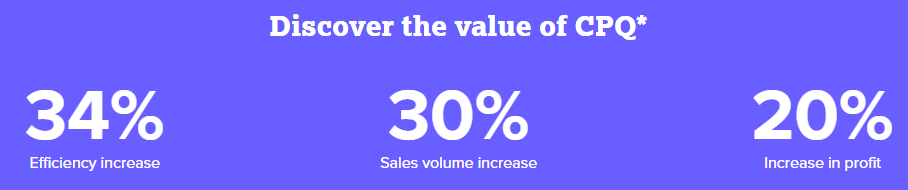
Being #1 for manufacturing isn’t something we take lightly; we are helping manufacturers achieve improvements in quoting, sales and profit based on a Tacton customer value study:  

Unparalleled product architecture  

Tacton’s unparalleled product architecture stems from its modularized design, which offers both vertical and horizontal scaling capabilities. This architecture allows businesses to seamlessly adapt Tacton CPQ to their evolving needs without disruptions to ongoing sales operations. The flexibility of Tacton CPQ’s architecture ensures that changes can be made swiftly and seamlessly, ensuring that no sales deal is ever interrupted due to IT-related tasks.  

Tacton CPQ architecture minimizes the burden on IT departments, as maintenance tasks are predominantly managed by the business users themselves. This empowerment of the business side not only reduces dependency on IT resources but also accelerates the implementation of changes, updates, and enhancements to the CPQ environment.  

As a result of the product architecture, Tacton CPQ boasts exceptional performance, effortlessly handling large system configurations, intricate pricing models, and generating quotes with remarkable efficiency. Its robust design ensures swift processing and optimization, empowering businesses to streamline their sales processes while maintaining accuracy and reliability even in the face of complex configurations and pricing scenarios. 

The product architecture of Tacton CPQ stands out as a solution where the agility and efficiency of the business are prioritized, ensuring uninterrupted sales processes and maximizing overall productivity. 

Continuous, and timely product features 

At Tacton we’ve unveiled several updates to our flagship product, Tacton CPQ, solidifying our position as the most comprehensive CPQ software tailored for manufacturers. Among the notable releases were Tacton CPQ Data Import Automation and Tacton Product Validations, which streamline processes and ensure accuracy in configuration.  

Additionally, Tacton introduced an enhanced version of its Salesforce integration, enhancing seamless data flow and collaboration. 

We’ve also made strides in Environmental Footprint Configuration and System Configuration, aligning with the growing focus on sustainability and operational efficiency. As sustainability becomes a larger focus for manufacturers, Environmental Footprint Configuration will help companies deal with conscious buyers and adhere to impending climate legislations.  

Proven track record of customer success across industries

Our proven track record, expertise in complex configurable manufacturing, and strong industry fit in sectors like food processing, industrial machinery, and specialty vehicles bolster confidence in our customers. We’re able to work with leading companies because of our ability to address the unique challenges and complexities faced by manufacturers.  

With our robust configurability and scalability, Tacton CPQ empowers manufacturers to efficiently manage intricate product configurations and streamline sales processes, resulting in faster quoting cycles and improved customer satisfaction. Moreover, our platform agnostic integrations to CAD, CRM, and ERP systems ensure seamless data flow and collaboration across departments, enhancing operational efficiency and accuracy.  

Additionally, our focus on innovation, coupled with our commitment to customer-centricity, enables us to continually adapt to evolving industry trends and customer needs, solidifying our position as the preferred CPQ solution for manufacturers seeking to drive growth and competitiveness in today’s dynamic market landscape. 

In closing 

Customer demand is at an all-time high, and manufacturers are taking notice and adding new solutions to help them quote and create better customer experiences. We couldn’t be happier to be the trusted configuration partner of manufacturers such as TCP Wire, HMF Crane, Swift Lifts and more. Find out how CPQ can take your operation to the next level by reading our free eBook, CPQ – A Mandatory Enterprise Solution for Sales Quoting” or schedule a quick chat with our experts!  

Chat with our experts!

Back to Resources

Revolutionizing Renewable Energy Manufacturing with CPQ

CPQ for renewable energy manufacturing can make all the difference in quoting complex products for a new conscious buyer

Revolutionizing Renewable Energy Manufacturing with CPQ

What is CPQ for Renewable Energy Manufacturing?

The demand for energy has never been higher in human history, this demand is driving countries across the globe to find new ways to produce energy. While the energy sector has historically been dominated by natural gas and coal there has been a sharp increase in renewable energy sources. The International Energy Agency (IEA) predicts that renewable energy sources such as solar and wind power will on average meet more than 90% of the increase in global demand by 2025. 

What are some common quoting challenges for renewable energy equipment manufacturers?

With a new emphasis on renewable energy sources, manufacturers who produce these products, such as wind turbines, will need to find solutions that help them easily sell their products. This isn’t an easy task, manufacturers face a multitude of challenges, from intricate product configurations to dynamic pricing models. Amidst these complexities, efficiency and accuracy are paramount.

How can CPQ help renewable energy equipment manufacturers sell faster?

Enter Tacton Configure, Price, Quote (CPQ) – a game-changer for renewable energy manufacturers seeking to streamline their operations and accelerate growth in this burgeoning industry.  At its core, Tacton CPQ is a robust software solution designed to simplify the complexities of configuring, pricing, and quoting renewable energy systems. Whether it’s solar panels, wind turbines, or energy storage solutions, Tacton CPQ empowers manufacturers to navigate the intricacies of product customization with ease and precision. 

Dynamic pricing models

Tacton CPQ offers unparalleled flexibility in pricing models. In the dynamic renewable energy market, pricing structures can vary based on factors such as geographic location, government incentives, and project specifications.

One example of government incentives is the European Union’s “carbon tariff” – the Carbon Border Adjustment Mechanism (CBAM).  This incentive is designed to level the playing field between EU companies that have strict environmental rules and foreign businesses that can sell cheaper exports partially thanks to lower sustainability regulatory requirements. When CBAM enters into force in January 2026, carbon-intensive EU importers of some materials or components will be mandated to purchase carbon certificates.  

Management consulting firm BCG estimates the EU tax could increase the cost of materials made by more carbon-intensive producers, such as China, Russia, and India by 15% to 30% overnight. This potential is causing manufacturers to reevaluate their supplier management strategy based on the location of select vendors. 

These incentives highlight how Tacton CPQ can adapt to different constraints (in this case, local regulations) seamlessly, enabling manufacturers to create tailored pricing models that align with their business goals and market dynamics. 

Accurate quotes with CPQ for Renewable Energy Manufacturing

Perhaps most importantly, Tacton CPQ revolutionizes the quoting process for renewable energy manufacturers. Generating accurate quotes in a timely manner is essential for securing sales and maintaining customer satisfaction. Tacton CPQ streamlines this process, allowing manufacturers to generate comprehensive quotes with just a few clicks. By automating manual tasks and eliminating errors, Tacton CPQ accelerates the sales cycle and enables manufacturers to capitalize on opportunities more effectively. 

Integrations

Tacton CPQ integrates seamlessly with existing enterprise systems, providing a unified platform for managing sales, production, and customer data. This integration enhances collaboration across departments, streamlines communication, and ensures consistency throughout the manufacturing process. 

Enhanced customer experience with visual configuration

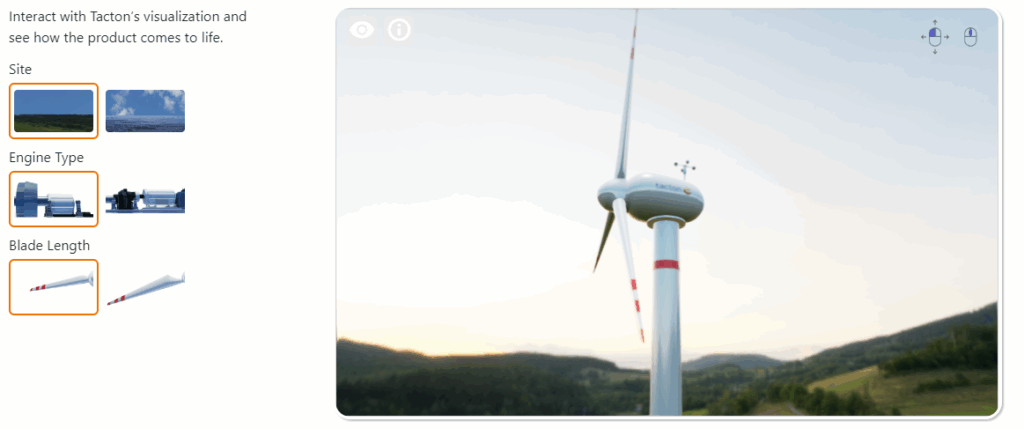
An additional advantage of Tacton CPQ is its advanced visualization capabilities. The software allows manufacturers to create interactive 3D models and visualizations of renewable energy systems, providing customers with a clear understanding of the final product. These visualizations not only enhance the customer experience but also facilitate better communication between manufacturers and clients, leading to faster decision-making and increased sales. Check out how we visualize a windmill here!

In an industry driven by innovation and sustainability, Tacton CPQ emerges as a catalyst for growth and success. By empowering manufacturers to streamline operations, enhance accuracy, and accelerate sales, Tacton CPQ enables renewable energy manufacturers to thrive in a competitive market. As the demand for renewable energy solutions continues to soar, embracing technology-driven solutions like Tacton CPQ is essential for driving progress and shaping the future of energy. 

Ready to learn more? Chat with one of our experts!

Let’s chat!

Back to Resources

Exploring the Future of AI and CPQ

AI and CPQ will be the next frontier for configuration solutions. Find out how they will work together in this guide

Exploring the Future of AI and CPQ

The future of AI and CPQ is playing out rapidly

Manufacturers are always looking for new and innovative ways to sell their products. With tough competition and changing customer profile it’s important to find ways to stay competitive. One solution many are turning to is Configure, Price, Quote software 

CPQ solutions have long been instrumental in simplifying complex sales processes. By automating the configuration, pricing, and quoting tasks, CPQ empowers sales teams to create accurate quotes quickly, ensuring consistency and reducing errors. As an industry leader, Tacton has been helping manufacturers transform their sales process for over 25 years. We are always looking for ways to grow to our customer demands. That said, we, like many, have seen the explosion of Generative Artificial Intelligence (AI) over the last year.  

As technology continues to evolve at a rapid pace, Artificial Intelligence and the emergence of AI are reshaping the sales landscape, promising unprecedented levels of efficiency, personalization, and innovation.  

In a recent Tacton survey, 59% of manufacturers showed some level of excitement for new tools that can help streamline their process. But with that excitement 20% of respondents are also very cautious about the future. This nuanced spectrum of sentiments underscores the importance of responsibly navigating the integration of AI in manufacturing, ensuring that its potential benefits are harnessed ethically for the industry’s continued advancement. 

While Tacton acknowledges the potential of AI and Gen AI trends, it recognizes the importance of looking beyond the hype and adopting a thoughtful approach to innovation. This symbiotic relationship between AI and CPQ is not just a trend; it’s a fundamental shift that promises to revolutionize sales processes and enhance overall business performance. Let’s take a deeper look at the future of AI and CPQ. 

AI: Empowering Intelligent Decision-Making 

Artificial Intelligence, with its ability to analyze vast amounts of data and identify patterns, is becoming the cornerstone of modern business operations. In the realm of sales, AI-driven insights are invaluable for understanding customer behavior, predicting market trends, and optimizing pricing strategies. By leveraging AI algorithms, businesses can uncover hidden opportunities, personalize offerings, and streamline sales processes for greater efficiency and effectiveness. 

CPQ: Streamlining Sales Operations 

Tacton CPQ streamlines the sales process by offering an intuitive platform for quick and accurate product configuration, automated pricing optimization, and efficient generation of customized quotes and proposals. Its seamless integration with other business systems ensures data consistency and real-time access to information, while collaborative features enable cross-departmental communication and visibility into the sales pipeline. By providing superior customer experience through personalized solutions and timely responses, Tacton CPQ empowers sales teams to drive revenue growth, exceed customer expectations, and build lasting relationships. 

The Future Integration: AI-Powered CPQ

The marriage of AI and CPQ represents the next frontier in sales technology. By embedding AI capabilities into CPQ solutions, businesses can unlock unprecedented levels of efficiency, agility, and intelligence across the entire sales cycle.

Here are some potential capabilities of CPQ and AI:

Enhanced Product Configuration:

AI algorithms can analyze customer preferences, past purchases, and market trends to recommend the most relevant product configurations in real-time. This not only accelerates the configuration process but also ensures that offerings are tailored to individual customer needs, driving higher conversion rates and customer satisfaction. 

Dynamic Pricing Optimization: 

AI-powered CPQ solutions can analyze a myriad of factors, including market demand, competitor pricing, and customer behavior, to dynamically adjust pricing strategies in real-time. By optimizing prices based on current market conditions and individual customer profiles, businesses can maximize profitability while remaining competitive. 

Intelligent Quoting and Proposal Generation:

With AI-driven predictive analytics, CPQ systems can generate personalized quotes and proposals that resonate with each customer’s unique preferences and buying behavior. By automating the creation of compelling sales collateral, sales teams can focus their efforts on building relationships and closing deals, rather than getting bogged down by administrative tasks. 

Predictive Sales Analytics:

By analyzing historical sales data and customer interactions, AI-powered CPQ solutions can provide valuable insights into future sales opportunities, allowing businesses to anticipate customer needs, identify cross-selling and upselling opportunities, and proactively address potential challenges. 

 The Road Ahead: Challenges and Opportunities for AI and CPQ 

While the future of AI-powered CPQ holds immense promise, businesses must also navigate potential challenges such as data privacy concerns, algorithm bias, and user adoption barriers. As AI technologies continue to evolve, there is a constant need for ongoing innovation, education, and collaboration to harness their full potential effectively. 

In closing

As businesses strive to stay ahead in an increasingly competitive marketplace, the integration of AI and CPQ emerges as a game-changer for sales and beyond. By leveraging the power of AI to augment CPQ capabilities, businesses can unlock new levels of efficiency, agility, and intelligence, driving sustainable growth and delivering superior customer experiences. As we journey into the future, embracing this transformative synergy will be essential for businesses looking to thrive in the digital age. 

Back to Resources

Improve How You Reach Customers with Self-Service

With Tacton Self-Service it's possible for your customers to quickly configure price and quote manufacturing products online.

Improve How You Reach Customers with Self-Service

In manufacturing to beat out the competition it’s important to enhance the customer experience in every way possible. One place that customers want to see change is how they get support for their unique issues. With inefficient processes leading the charge for customer issues, it’s important to nail how you support individuals who need help. It is essential to support your customers, so they keep coming back for more purchases.

Customers also want a place where they can configure the products they want to purchase. One way to eliminate these inefficiencies is to offer self-service where customers can find answers while also building their orders.  67% of people prefer self-service over speaking to sales reps, making it important to offer the people what they want.

What is self-service?

Customer self-service is a place where customers can get instant answers and fixes for their issues with your product. Offering self-service can help take the pressure off your support team by offering an alternative to calling or emailing. Self-service can also offer a place to showcase and purchase. Having a great self-service gives your customers a sense of control over the process instead of feeling helpless. Offering a mobile-enabled self-service app will also allow your customers to work out their problems from anywhere, at any time.

Self-service can also be used to sell your products, something that used to be difficult with complex product configuration. Now it’s possible to allow your customers to build their own quote for your custom products. Allowing your customers to build what they want on their own time will keep them engaged with your product.

Online self-service can also be a powerful marketing tool. Having a great self-service will keep customers engaged with your company by enabling a place for support and also products and customer success stories.

What is the problem without Self-Service?

Customers are more online than they’ve ever been and they want products and answers fast. Having a helpline with limited hours doesn’t help because everyone’s been on hold, leading to frustration. The B2B buyers want convenience, they don’t want to wait on the phone for answers.

Without a self-service option, it makes customers more likely to tie up your sales team with questions. With self-service, it’s possible to send customers somewhere that your product portfolio is easily and readily available.

Emailing has made it easier to communicate quickly with users, but it takes time that the customer may not have or be willing to sacrifice. Email may also get lost in the shuffle of hundreds of other issues your support team is working on.

If your business only offers the old ways of doing this, you may lose business to the competition that offers an online self-service. Consumers don’t want to rely on someone else, they want to be able to quickly address their issues. Offering an efficient way of supporting your customers without them getting on the phone or sending an email will go a long way in keeping them with your company. This impatience makes it integral to your customer experience to provide a service that allows them to get answers fast.

It’s clear that not having a self-service can cause headaches for your sales support team and customers. But what goes in the self-service is equally as important as actually having one. Without good information, your self-service will fail to help anyone. Also without a self-service shopping cart, your customers won’t be able to interact with your products.


What things should come with self-service?

Having the right type of features and applications on your self-service can change your customer experience.

  • An online store: A place where your customers can configure, price and quote their own products.
  • Knowledge articles: FAQs, product sheets, how-to articles, blogs and even customer stories can go a long way to helping your customer find a solution on their own, while also showing your additional features quickly and effectively.
  • Demo videos: Offering a visual of common problems can help customers who are more likely to watch a short how-to video instead of reading a long-form problem-solving article.
  • Community forums: This may not be essential to all good self-service, but it’s something worth discussing. Offering a place where your different customers can interact with each other to crowdsource answers to problems can go a long way to solving different issues. These forums may require moderation which may make having this feature be more of a headache.
  • Somewhere to submit a ticket: This would be the last option, allowing your customers to submit an issue that they weren’t able to solve in the self-service. This can help streamline your processes by having one place for all tickets to go through instead of having a long phone call or an email chain.

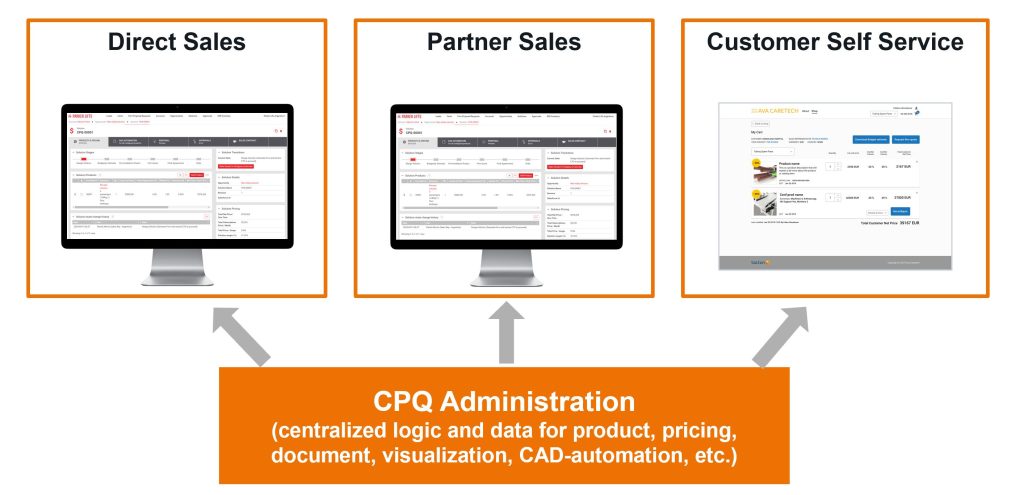
For many years now, Tacton has been offering omnichannel sales to B2b Manufacturing companies, empowering them to bring the power of Configure-Price-Quote technologies not only to Direct Sales, but also to their partners and end-customers.

If you want to learn more on how Tacton CPQ Omnichannel makes self-service sales achievable – even for highly individualized industrial products – head over to our web page or schedule your personal demo today!


Back to Resources

Top Reasons Why Manufacturers Trust Tacton

Why Tacton? Manufacturers have trusted our CPQ for years, find out the top 9 reasons why in this short blog

Top Reasons Why Manufacturers Trust Tacton

With a quarter century of successful innovation and growth validated by several years of recognition as a Leader in the 2023 Gartner® Magic Quadrant™ for Configure, Price and Quote Applications, many in the CPQ world ask:

What does Tacton offer that continues to build their partnerships with existing customers and drives new customers to select Tacton as a trusted partner?

To help answer this, let’s explore the top reasons why manufacturers choose Tacton:

1. Recognized Leader in CPQ, Validated by Industry Analysts

Tacton CPQ naturally stands out in the market, offering a comprehensive Configuration, Pricing, and Quoting (CPQ) solution that is both flexible and customer centric. This integrated approach is highly valued by customers for its low maintenance costs on a SaaS platform, centralized information for sales teams, and rapid time to value. Recognized by analysts such as Gartner® for its well architected platform and endorsed by users, Tacton is particularly recommended for complex manufacturing industries.

2. Tacton Lets Customers Focus on Revenue, Profitability and Quality and Not on Building a CPQ

With 25 years of experience, Tacton knows the nuances of manufacturing sales. Tacton CPQ is designed for quick deployment and ease of use with a configurable UI, sparing customers the effort of developing an in-house solution. Tacton’s industry-leading backend and customizable frontend, along with a robust API, facilitate the integration of existing systems, providing a comprehensive user experience without overhauling legacy systems.

3. Native Visualization to Manage Growing Customer Experience (CX) Needs 

With most manufacturers focused on improving their customer experience and buying journey, Tacton sets itself apart with its native Visualization capabilities. Unlike many CPQ providers who rely on third-party suppliers, Tacton’s Visualization is developed in-house and seamlessly integrated with the CPQ system. This ensures that customers have a robust visual configuration tool right out of the box, enhancing the buying experience without the hassle of managing multiple vendors or integration challenges. 

4. Purpose-Built for Scaling with High Performance

Tacton CPQ is designed for scalability and performance. By decoupling data from logic statements, Tacton makes system maintenance easier and more efficient, even with complex manufacturing setups. This methodology surpasses traditional rule-based setups, especially in handling extensive product options and configurations, thus avoiding performance degradation and high maintenance costs. 

5. Unparalleled Configuration Technology

Tacton’s unique run-time constraints solver, developed specifically for manufacturing complexity, offers unmatched flexibility and ease of use. This technology, honed over 25 years, simplifies product offering setups and is key to successful CPQ implementations. Tacton employs rule-based configuration in limited, specific scenarios to ensure maximum adaptability for customers. 

6. Platform Agnostic Integration

Tacton’s open API and extensive integration experience with CRM, ERP, PLM, and other tools ensure seamless connectivity with both new and legacy systems. This includes embedded integrations with Salesforce CRM and MS Dynamics. Tacton’s Data Import Automation further streamlines data updates from other systems, accommodating both on-premise and cloud setups. 

7. A Full SaaS Offering Battle-Tested and Continuously Improved for Nearly a Decade

Tacton has been a trusted partner in the complex manufacturing sector for 25 years, offering a robust SaaS solution with multitenant functionality. This ensures seamless, secure, and low-maintenance data management on the cloud, with global reach and reliability. 

8. Best in Industry for Administration/Maintenance of CPQ

Tacton’s unified interface for Product Modeling, Price Modeling, CAD Modeling, and CPQ Modeling simplifies the administration and maintenance of the system. This comprehensive approach significantly reduces maintenance costs and streamlines updates for new requirements, setting Tacton apart as a leader in CPQ solutions. 

9. Unmatched Services and Support: The product reasons discussed above are a major reason for building trust but Tacton prides itself in the relationships built with customers. This trust is built by delivering the right type of expert implementation service and continued support in ensuring a successful outcome for manufacturers.

Get the full guide to Tacton Implementation here

In summary, Tacton’s CPQ solution offers a unique blend of innovation, integration, and intelligence, tailor-made for the complexities of the manufacturing sector. It stands out for its industry-validated leadership, native visualization, and focus on creating value rather than system building. Tacton’s purpose-built scalability, unparalleled configuration technology, and platform-agnostic integration are designed to meet both current and future needs of manufacturers. As a full SaaS offering, it ensures seamless, secure, and efficient operation globally.  

Finally, Tacton is acclaimed for its exceptional ease of administration and maintenance, making it a top choice for manufacturing companies aiming to enhance their CPQ processes. We believe customers embrace Tacton to navigate the complexities of manufacturing sales with ease and efficiency, positioning their business at the forefront of technological advancement and customer satisfaction. 

Want to learn more? 

Connect with SR on Linkedin! 

Back to Resources

Make Ordering Highly-Configurable Products Easier with Self-Service

Make it easier than ever to order products online, complete with CAD documentation, accurate quotes and more with CPQ software for manufacturing

Make Ordering Highly-Configurable Products Easier with Self-Service

The classic B2B sales model is rapidly changing. Customers want B2C-like experiences in every purchase, which includes high variance manufacturing products as well. Let’s take a look and see what solutions are helping manufacturers deliver on B2C promises.  While topics such as customer expectation and experience are discussed by manufacturers many companies do not even offer customers the most basic online functionalities.

These stats from “Death of a (B2B) Salesman” by Forrester Research show that immediate action is needed  

  • 53% of the B2B buyers questioned: “I prefer to search even online for information. “
  • 59% of the B2B buyers surveyed: “I would rather not communicate with a sales consultant.” 
  • 74% of the B2B buyers surveyed: “Purchasing via a website is more convenient.” 
  • 93% As soon as I’ve decided on a product, I prefer to buy it online. 

To stay competitive, manufacturing companies need digital buying tools that meet the preferences of self-service-oriented buyer, including the possibility to configure highly individualized solutions for their needs. 

A central component of B2B commerce: The Digital Customer Portal  

B2B customers are increasingly gathering information online before making a purchase decision and expect to be able to order the selected product online. In view of these developments and challenges, B2B companies must rethink and reinvent their sales models in terms of consistent customer demand.  A digital customer portal offers customers user-friendly websites and online shopping with comprehensive product information, guided selling, needs-based configuration, consistent and transparent pricing, intuitive ordering functions, and modern checkout processes. 

With a digital customer portal, B2B manufacturers can: 

  • Better serve customer needs thanks to self-service tools 
  • Increase your own sales by becoming the preferred provider 
  • Develop and digitalize your own sales model according to your buyers’ expectations  

Keep up with customer demands
Business customers today expect a shopping experience that is similarly different from what they are used to privately from the B2C area. Conventional B2B sales and distribution processes cannot keep up with this development – and cause a lot of frustration among digitally demanding B2B buyers. 

What for?  

For instance, a product with 500 configurable components has 2.3×10133 possible options that can be offered. Your sales team needs a lot of expertise and must invest a lot of work hours in order to create a correct quote. That’s not even including other required information such as 3D models, drawings, product information, and documentation.

The linchpin of a self-service portal is a configuration you can trust

A powerful product configurator is the interface between the customer and the system and ensures that all configurations are always technically correct and – above all – can be produced. Since the buyer is not necessarily an expert of your product features, but focuses rather on the business outcomes and value of your product, a self-service portal has to support needs-based guided selling.

I needs-based product configuration guarantees

  • that the actual needs of the customer/prospect are recorded intuitively and that the product variant offered addresses those needs
  • that non-technical requirements, such as total cost of ownership, energy consumption, or specific performance indicators can be translated into technical details 
  • that the configured products are always technically correct and based on current data. 

In order to enable customers and interested parties without detailed technical knowledge to put their products together independently, the system assists in resolving conflicts. For example, invalid options and variants are hidden during configuration and valid alternatives are suggested automatically. 

With a product configurator, manufacturing companies can overcome the typical bottlenecks in the sale of highly varied industrial goods. Manufacturers open new possibilities by automating procedures and processes and making them less error-prone. By using a powerful configuration solution, construction and sales processes can be automated and accelerated. 

Bottle Neck sales support 

The core task of technical sales support is to ensure the technical feasibility of a proposed (offered) solution. In-depth product knowledge is necessary for this, as complex, varied products go hand in hand with a complex offer, price, and discount structures. Customer-specific machines and systems must meet special requirements. A lot of expertise is necessary to ensure that the selected solution meets these requirements and can later be operated safely and successfully.

Bottleneck incoming orders 

Not only the preparation of an offer is time-consuming – order entry and order processing are also. Even more: Inefficient processes and incorrect orders have serious effects (long processing times) and quickly cause high costs (warranty costs) and lead to dissatisfied customers. 

Convenient self-services for users

Manufacturing companies that decide to introduce a digital self-service or customer portal benefit from holistic processes and a seamless tool for end-to-end customer interaction.

Web-based self-services are becoming increasingly important for industrial companies. When looking for information, B2B customers now research the providers’ websites first – but shy away from contacting a sales consultant. A self-service customer portal not only simplifies the registration of new customers and customer management. It also improves the customer experience and provides better service.

After all, B2B buyers expect the same features and functionality as those offered by leading online retailers. This includes:

  • All configurations previously created “anonymously” are visible
  • Further processing of a configured product
  • The current price information is displayed for the configurations created
  • Information and additional services are unrestrictedly accessible
  • The complete product catalog is available even non-configurable accessories, additional services (e.g. maintenance, extended warranties), spare parts, and consumables to the product
  • Request a quote based on a configuration you have made

As soon as the registered user’s request has been received, a sales representative can process, check and adjust the request and release an offer in the portal. There it can be opened and checked by registered users.

Document Generation and self-service

Creating accompanying advanced documentation is an important part of self-service. Creating items such as CAD documents empowers your customers to close the deal by going the extra mile and speeding up a process that would take weeks and turning it around in minutes.

Order Processing

If both sides (an interested party and provider) agree with the offer, the user can confirm the offer. It will be frozen and the order will be processed. The self-service portal transfers the order directly to the connected ERP system, which processes it further.

Self-service portals increase the efficiency of the internal order processing process and the transparency of the order status. Customer advice and support can be provided more easily and cost-effectively. By eliminating manual tasks, sales and customer service can focus on interactions that create value for business customers.

In closing

A self-service portal bundles all applications and services required for the distribution and sale of industrial goods on a central platform, which can also be seamlessly connected to the rest of the technology landscape via interfaces. If you want to learn more on how Tacton CPQ Omnichannel makes self-service sales achievable – even for highly individualized industrial products – head over to our web page or schedule your personal demo today!

Back to Resources

5 Best Practices to Optimize Your Engineer to Order Process

Explore our guide on engineering-to-order manufacturing. ✓ Get insights into custom solutions for your industry and best practices to optimize your ETO process.

5 Best Practices to Optimize Your Engineer to Order Process

The Ultimate Guide to Engineering-to-Order Manufacturing

Amidst the escalating trend of personalization, the demand for tailored manufacturing solutions has reached unprecedented levels. However, this shift towards customization poses significant challenges for manufacturers. Traditional advantages of mass production, such as economies of scale and uniform inventory, are compromised.

To address this, a paradigm shift in manufacturing strategy is required – embracing the engineer-to-order approach. This method allows manufacturers to adapt and thrive in an environment where bespoke production is increasingly valued.

Before we go into the benefits and details, let’s start with a simple engineer-to-order definition.

What is Engineer-to-Order?

Engineer-to-order (ETO) refers to a manufacturing approach where products are custom-designed and built to meet the unique specifications of individual customers.

The primary advantage of engineering-to-order is flexibility. It allows manufacturers to develop nearly anything for their customers, giving them a competitive advantage in the marketplace. You can also charge a premium for ETO products, which helps with revenue.

But that flexibility is also a considerable challenge. Each project involves varying materials, components, and manufacturing processes. Standardizing everything in ETO is difficult, so lead times are typically longer than in mass manufacturing.

Other challenges of ETO include more risks and uncertainty (since the project has never been done before), supply chain issues, and quality control.

Because of ETO’s complexity, it often requires a careful approach. For instance, project management is more demanding as you must coordinate different departments like design and manufacturing. The design phase is also longer and involves extensive back-and-forth for approval.

Engineer-to-order examples are often found in industries that require customized solutions, such as construction, aerospace, industrial equipment, and shipbuilding.

The Difference Between Engineer-to-Order and Make-to-Order

Engineer-to-order is often confused with another manufacturing approach, make-to-order (MTO).

MTO is a method where products are only created when a customer places their order. MTO and ETO contrast with Make-to-Stock (MTS), where manufacturing is done to anticipate customer demand.

What separates ETO and MTO is the level of customization involved.

ETO products, as we’ve discussed, are heavily customized. In contrast, MTO goods require little to no customization. Often, any changes are only minor variations of standard or pre-existing designs. 

A good example is a laptop that looks similar to its peers but differs in the underlying specs. Because of this, MTO has a significantly shorter lead time than ETO. In fact, the effectiveness of MTO relies on churning out products quickly to customers.

Inventory management is also different. ETO components are sourced as needed since each project is unique; therefore, inventory usage is minimal. MTO’s limited configuration means it relies more on stocks of standard raw materials.

The Engineer-to-Order Manufacturing Process

Now, let’s go through the steps in a typical ETO workflow.

Specifications and Quoting

The first step in the ETO process starts when a manufacturer gets a request for quote (RFQ) from a client. The client’s aim is to get different price offers from various manufacturers, compare them, and then choose the best one for their project.

An RFQ is a formal request for pricing and detailed information about a specific project or customized solution. RFQs usually contain technical requirements, quality standards, a target budget, and a proposed timeline. 

If a manufacturer thinks it can take on the RFQ, it responds with an initial quote. Here, designers and engineers collaborate on creating a product specification and pricing that fulfill the RFQ’s requirements.

Clients rarely go with the first quote. They often request changes or compromises, which the manufacturer will revise and resend for approval. This back-and-forth process continues until both parties arrive at a final quotation.

Design and Engineering

With a final quote and specification on hand, the manufacturing firm proceeds to flesh out the product design that’s ready for production.

To achieve this, the design team starts with a conceptual product design. Designers create sketches, wireframes, and other initial designs. 

The engineering team is often involved in ensuring the real-world feasibility and safety of the design, addressing specific dimensions, materials, and tolerances. Designers then refine the product drawings to reflect their suggestions.

Computer-aided design (CAD) is also utilized to simulate and validate the design. The team can also send the CAD drawings to the client for feedback and approval.

Process Planning

After the final product design is decided, the next step is to devise a process to implement it. This is where process planning comes in.

Process planning is essential in engineering-to-order due to the distinct nature of each project, requiring the custom design of the entire manufacturing process to align with the project’s unique specifications.

The goal is to design the project’s most efficient and cost-effective production pipeline. It’s also a chance to identify potential issues early so the team can address them. Without this step, you risk creating a product of lower quality and higher cost.  

Process planning begins with a thorough review of the specifications and other relevant details by the production team. Through this, they’ll determine the processes required and the best sequence to execute them.

Part of this step is allocating the right resources to the project. This includes scheduling machine time, staffing, raw materials, and auxiliary services.

Product Concept Confirmation

Before the final product design is transferred to the production team, it is essential to complete a critical confirmation step.

Here, the specifications are reviewed and validated to ensure alignment with the customer’s requirements and expectations. A meeting with the client is often done to clarify any ambiguities and address questions.

The team will also send everything that needs approval. These include the final costs, bill of materials (BOM), projected timeline, and manufacturing process. Changes can be suggested by the client if needed.

Once the client provides the final approval, the production process begins.

Manufacturing

This step is where the rubber meets the road.

First, the workflow devised during the process planning stage will be implemented here. Machines and special equipment are procured, installed, and tested. Then, the fabrication of the individual component begins.

Rigorous quality assurance is also implemented throughout the process to verify that every step meets all specifications and performance requirements. For specific projects, customer acceptance testing (CAT) may be utilized.

The components are then assembled into the final form and tested thoroughly. Finally, the product will be dispatched for delivery to the client.

A dedicated installation team will set up the product and officially hand it over to the client if required. Additionally, training sessions can be organized to help the clients understand how to use and maintain the product effectively.

5 Best Practices to Optimize Your Engineer-to-Order Process

Complexity is a natural part of ETO, meaning work times for projects tend to go over time and budget. However, there are certain best practices you can do to minimize this. Here are some examples:

Establish Open Communication

Open communication is critical for success with engineered-to-order processes. It ensures that your team thoroughly understands the client’s requirements, expectations, and preferences so you can create a perfect product for them.

Collaboration between teams is also required with ETO, and this is something open communication can facilitate. Without it, the product can’t flow smoothly from one step to the next.

There are many ways to implement open communication, but the best way is through having clear communication protocols. For instance, you can require everyone to use project management software to track all the moving parts. Having regular team meetings in person or via Zoom is also helpful to keep the team on the same page.

Use CPQ Software

Engineer-to-order software can streamline the entire engineering-to-order process. One of the most critical in the early stages is CPQ software.

CPQ (Configure, Price, Quote) software like Tacton CPQ streamlines the specification and quoting process. It allows anyone – even non-technical users – to create product specifications, features, and components using a graphical UI.

More importantly, CPQ software automatically generates pricing and quotations from the set product specification. These can be flexible enough to account for discounts, bundle pricing, and other pricing schemes.

CPQ software significantly enhances the efficiency of the planning process. This tool lets sales agents quickly generate precise specifications and pricing details based on a client’s needs, often within just a few hours. This rapid turnaround enables them to secure more deals in a shorter time, thereby boosting the company’s revenue.

Moreover, once the quote is approved, these specifications can be automatically transformed into CAD drawings. These are then seamlessly forwarded to the engineering team, eliminating the need for manual creation and transfer of files, which often leads to errors. This streamlines the entire process, ensuring accuracy and efficiency.

Standardize Procedures

While ETO projects are unique by nature, several aspects of the process can be standardized. This is the secret to making ETO more efficient and cost-friendly.

For example, you can create standardized templates for key project documents such as plans, design specifications, and quality control procedures. Having templates can save you plenty of time when drafting these key documents.

You can also outline standard engineering steps that apply to every engineering-to-order project. For instance, every product would require testing, inventory management, prototyping, and design validation. Creating common SOPs and implementing them across every project you do ensures consistent quality.

Focus on Documentation

Documentation is critical to navigating the complexities of ETO projects. It is a clear reference point for all stakeholders, including engineers, designers, project managers, and the client. Without it, it’s easy for one or two teams to go off completely off-track.

There are many ways to implement adequate documentation.

One strategy is to have a clear version control system to track document changes. Clearly indicating updates to a document can help avoid confusion and eliminate the risk of anyone working on outdated information.

You can also require every team to accomplish and submit progress reports. This document provides task status, achievements, challenges, and upcoming milestones of every person involved in the project. It’s a practice that promotes transparency and helps managers detect potential problems before they arise.

Finally, ensure all documents are located on a cloud-based, centralized repository for easy access.

Track Key Metrics

Metrics are essential for gauging the progress and success of an ETO project. They can also help you see the early signs of trouble so you can course-correct immediately.

For example, the defect rate metric measures the percentage of items produced that are broken to the point of being unusable. Lowering your defect rate requires looking at your production process and equipment.

Another is resource utilization rate, a metric that assesses how efficiently resources (like labor and equipment) are used throughout the project. You want to maximize your utilization rate to keep costs low.

There are dozens of other metrics you can use. What’s important, though, is to adapt those metrics that are relevant to you.

CPQ Software for Engineering with Tacton Systems

As you can see, engineer-to-order projects are some of the most challenging and complex in the manufacturing industry. To succeed, you’ll need to automate some of these complexities so your team can focus on designing and building successful products.

This is where Tacton CPQ software for engineering can help you.

Our system can help streamline some of the most tedious parts of the sales process. Design a product specification, calculate pricing, and generate a professional quote in a fraction of the time.

It’s clear why Tacton stands as the premier CPQ solution in the manufacturing sector, earning the trust of industry giants like Yaskawa, Husky, and Siemens. With a solid 25-year history of innovation, you can rely on us to provide cutting-edge solutions that will enhance the agility and profitability of your manufacturing business.

Want to learn more about Tacton CPQ? Contact us now to schedule a free demo.